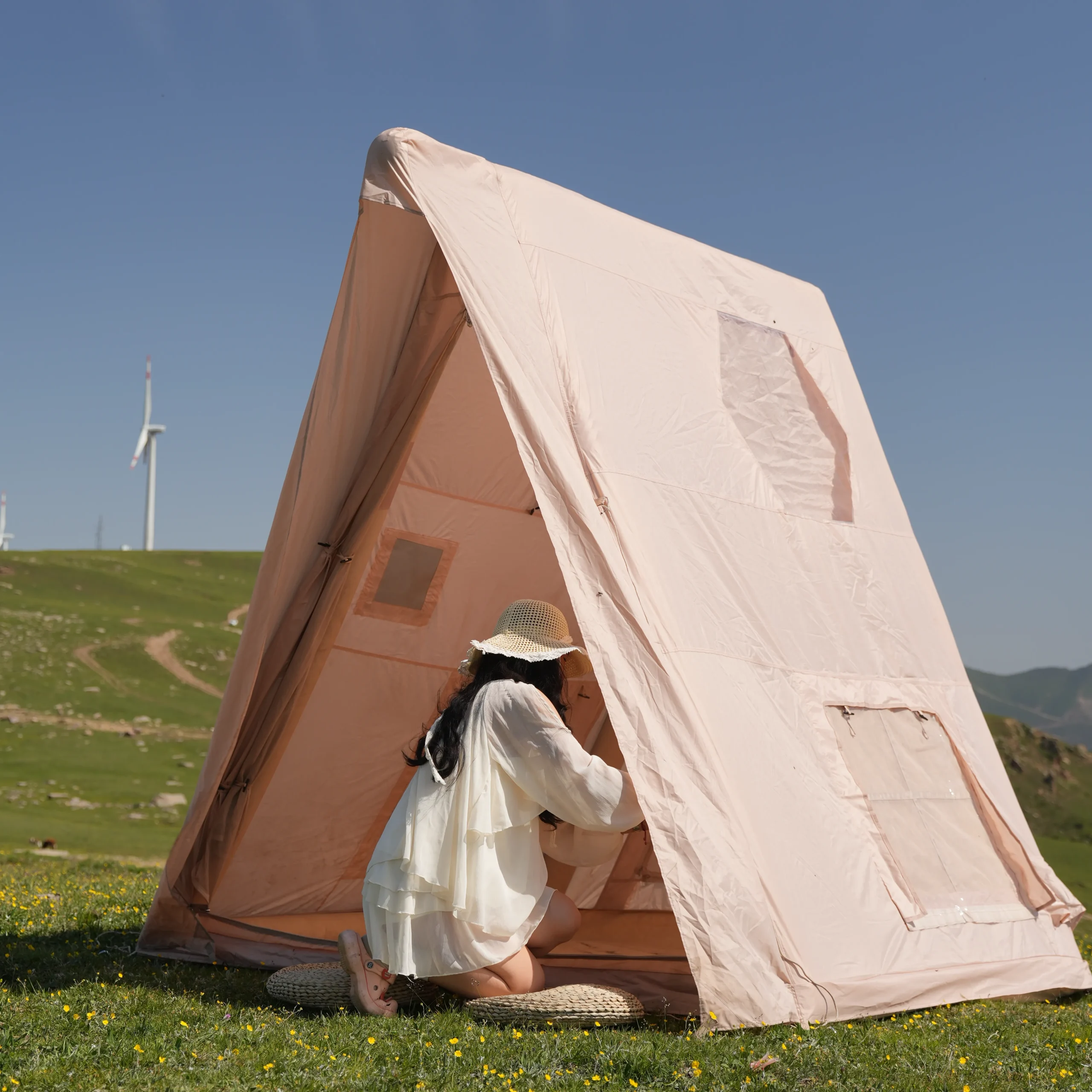








Inflatable Tent Setup Time Compared: How Does It Compare With Other Tents?
When you arrive at a campsite after several hours on the road, the last thing you probably want to do is spend a long time figuring out your tent.
This is where setup time becomes important.
Inflatable tents have gained attention because they use air beams instead of a traditional pole frame. But does that always mean they are faster?
Not necessarily.
The actual setup time depends on the size and design of the tent, the campsite, the weather, and the experience of the person setting it up.
Rather than asking which type is always faster, it makes more sense to look at how the setup process differs.
How Long Does an Inflatable Tent Take to Set Up?
There is no single setup time that applies to every inflatable tent.
A small two-person model and a large family tent are completely different.
The basic process is usually simple: position the tent, connect the pump, inflate the air beams, and secure the tent.
The number of air beams and the size of the tent will affect how long the process takes.
Your experience matters too.
Someone setting up an inflatable tent for the first time may need to stop and check the instructions several times. After a few trips, the same process can become much quicker.
How Does a Pole Tent Compare?
Traditional pole tents use a different approach.
Instead of inflating the structure, you normally need to assemble the poles and connect them to the tent.
Depending on the design, this can involve several separate pieces.
You may need to identify different pole sections, connect them together, feed them through sleeves, attach them to the corners, and then raise the tent.
For an experienced camper, this can be straightforward.
For someone using the tent for the first time, however, it may take a little more trial and error.
Inflatable Tents Reduce Frame Assembly
The biggest difference is how the main structure is created.
With a traditional pole tent, the frame has to be physically assembled.
With an inflatable tent, the air beams provide the structure once they are inflated.
You still need to position and secure the tent properly, but there are fewer individual frame components to connect.
For campers who don’t enjoy dealing with multiple poles, this can make the setup experience feel much easier.
Bigger Tents Take More Time
It’s important to compare similar tents.
A compact pole tent might be faster to set up than a large inflatable family tent simply because it is smaller.
A large inflatable tent may have several rooms, more air beams, more fabric, and more anchoring points.
That extra space is useful once the tent is ready, but it naturally means there is more to set up.
The same principle applies to traditional tents.
Size matters regardless of the construction method.
First-Time Setup vs. Experienced Setup
Setup time can change considerably after a few camping trips.
During your first setup, you’re learning the tent.
You might ask yourself:
Where does the pump connect?
Which valve should I use?
Where do these guy lines go?
How should the tent be positioned?
After you’ve answered these questions once, you don’t need to think about them as much.
This is true for both inflatable and traditional tents.
Experience often matters almost as much as the tent design itself.
What About Packing Up?
The comparison shouldn’t stop at setup.
Packing away your tent is also part of the camping experience.
An inflatable tent needs to be properly deflated, folded, and stored.
A traditional tent needs its poles disassembled and the fabric packed away.
If the tent is wet, both types require additional care.
You may need to dry the tent properly before long-term storage to help prevent unpleasant odors and moisture-related problems.
Which Is Better for Family Camping?
For families, convenience can be especially important.
You may already have children waiting to get inside, bags to unpack, food to organize, and other campsite tasks to handle.
A straightforward setup process can make arrival much less stressful.
An inflatable family tent can also offer a spacious interior once it is standing, giving everyone room to sleep, sit, and organize their belongings.
For many families, that combination of setup convenience and interior space is more important than saving a few minutes.
What About Weekend Camping?
Setup time can matter even more when you’re only camping for one or two nights.
If you’re spending a short weekend outdoors, you probably don’t want to spend a large part of your trip assembling and packing equipment.
An inflatable tent can be a convenient option for this kind of camping because the main structure is created through inflation rather than assembling a multi-piece pole frame.
Once you’re familiar with the tent, the process can become very routine.
Does Setup Time Matter on Longer Trips?
Not as much.
If you’re staying at the same campsite for a week, spending a little extra time setting up isn’t usually a major concern.
In that situation, other factors may be more important.
You might care more about:
- Interior space
- Ventilation
- Sleeping comfort
- Weather protection
- Storage
- Durability
- Layout
This is why the fastest tent isn’t automatically the best tent.
Inflatable Tent vs. Pole Tent: Setup Comparison
Inflatable Tent:
- Uses air beams instead of traditional poles
- Requires inflation before securing the tent
- Fewer frame components to assemble
- Can be straightforward once familiar
- Large models may still require more setup time
Traditional Pole Tent:
- Uses a physical pole frame
- Requires pole assembly
- May involve sleeves and multiple connection points
- Setup varies significantly between designs
- Familiarity can make the process much faster
There is no universal winner.
A simple pole tent can be extremely quick, while a large inflatable tent may naturally take longer.
The better choice depends on the type of camping you do.
What Should You Look For?
If you frequently move between campsites, setup convenience may be high on your list.
If you normally camp with your family, interior space and organization may matter more.
If you camp mainly during weekends, a straightforward setup can make short trips more enjoyable.
And if you simply don’t like assembling tent poles, an inflatable tent may be worth considering.
Think about your entire camping routine rather than focusing only on the number of minutes required to put up the tent.
Final Thoughts
Comparing inflatable tent setup time with traditional tents isn’t as simple as saying one type is always faster.
Tent size, design, weather, campsite conditions, and user experience all make a difference.
What inflatable tents offer is a different approach to setup. Instead of building a frame from multiple poles, you inflate the air beams and then secure the tent.
For campers who value a straightforward setup and plenty of interior space, that can be a meaningful advantage.
At the end of the day, the best tent is the one that fits your camping style.
Because camping should be about enjoying the outdoors—not spending half the day figuring out your tent.
#InflatableTent #InflatableTentSetup #TentSetupTime #InflatableTentVsPoleTent #CampingTent #AirTent #FamilyCamping #CampingTips #QuickSetupTent #OutdoorCamping